
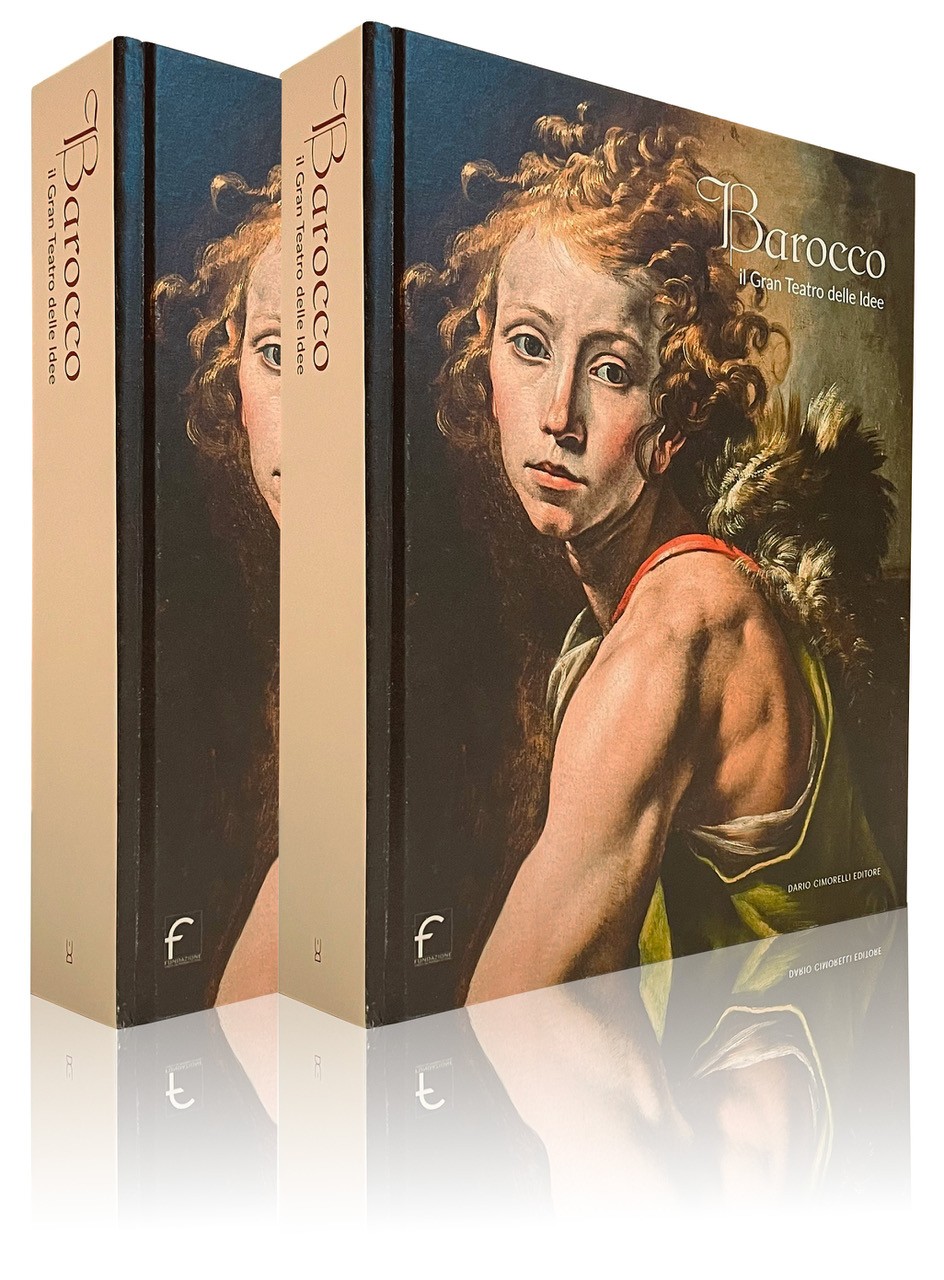
19 Mar ‘BAROCCO. IL GRAN TEATRO DELLE IDEE’, FROM THE PUBLISHER DARIO CIMORELLI, WITH TECNOSTAMPA, LORETO, ITALY.
Baroque. The Grand Theatre of Ideas.
Until 28 June, the Museo Civico San Domenico in Forlì is hosting an ambitious new exhibition project: ‘Barocco. The Great Theatre of Ideas’, a major exhibition dedicated to one of the most fascinating and complex periods in the history of European Art.
200 masterpieces, from Bernini to Bacon. Accompanying the exhibition is a catalogue published by Dario Cimorelli Editore.
The seventeenth century was the era in which the image ceased to be a mere representation and became a construction of reality. With the Baroque, light becomes matter, space expands, and the work engages the viewer in an emotional and persuasive experience. Rome was at the heart of this visual revolution. The contortions of the Laocoön Group and the sculptural power of the Belvedere Torso ignite a new concept of pathos. It was in this context that the Caravaggesque rupture emerged: in The Crowning with Thorns, Caravaggio depicts tangible suffering, illuminated by a glancing light that reveals human fragility and truth.
Tanzio da Varallo (Antonio d’Enrico) is currently one of the main figures featured in the major exhibition “Barocco. The Great Theatre of Ideas” at the San Domenico Museums in Forlì. The artist’s main work on display is the famous “David with the Head of Goliath” (c. 1623–1625), on loan from the Pinacoteca di Varallo. The painting is a masterful example of Tanzio’s Northern Caravaggism, characterised by a raw realism and an almost Mannerist dramatic tension.
Housed in the spaces of the Museo Civico San Domenico, between the Church of San Giacomo and the rooms of the former convent library, the exhibition brings together over 200 works from major museums and collections, including the Gallerie Nazionali di Arte Antica in Rome – Palazzo Barberini and the Galleria Corsini. Designed by the Lucchi & Biserni studio, the exhibition is divided into ten sections and offers an immersive journey that highlights the profound connections between art, power, faith, science and society in 17th-century Europe.
The exhibition is curated by Daniele Benati, Enrico Colle and Fernando Mazzocca, in collaboration with the art historian Bernard Aikema. The scientific committee is chaired by Cristina Acidini, while the overall direction is led by Gianfranco Brunelli. Sponsored by the Fondazione Cassa dei Risparmi di Forlì in partnership with the Municipality of Forlì, the exhibition takes visitors on a journey through Baroque civilisation, exploring its diverse artistic expressions and the cultural context that led to its emergence and spread.
Why ‘Baroque’ originated as a derogatory term: Not everyone knows that the term ‘Baroque’, now used to refer to one of the most spectacular periods in the history of art, initially had a negative connotation. During the eighteenth century, with the rise of Enlightenment culture and Neoclassical taste, critics and intellectuals began to judge the art of the seventeenth century as excessive, overly decorative and far removed from the ideal of balance and rationality attributed to classical antiquity. The word itself is thought to derive from the Portuguese term ‘barroco’, which referred to an irregular pearl: something strange, imperfect, not conforming to the norm. For a long time, therefore, ‘Baroque’ was used to describe a style considered bizarre, complicated and even decadent. It was only between the late nineteenth and the twentieth centuries that art historians gradually began to reassess this period, recognising its extraordinary inventiveness and cultural complexity.
This richness is also particularly evident in Baroque music, which reaches heights of extraordinary formal sophistication and spiritual depth. A prime example is Johann Sebastian Bach, whose oeuvre represents one of the pinnacles of European culture: in his compositions, the complexity of the musical language is combined with a rigorous internal structure and an intensely expressive dimension. His music demonstrates that the Baroque was by no means an era of unbridled excess, but rather a period of the highest intellectual and artistic sophistication. Today, the Baroque is seen as one of the most dynamic and innovative expressions of European civilisation, capable of interweaving art, thought, faith and power into an intense and theatrical worldview.
Art, architecture, music, literature, and public ceremonies function as forms of representation capable of bringing ideas, values, and worldviews to life. Churches, squares, palaces, and even cities become symbolic stages where the great ideas of the time are enacted: the faith of the Counter-Reformation, the magnificence of monarchies, and new scientific and philosophical visions. The title “Grand Theater of Ideas” thus suggests that the Baroque is not merely a rich and decorative artistic style, but a complex cultural system in which images, architecture, music, and public rituals collaborate to stage the fundamental ideas of seventeenth-century European society.
In this sense, the exhibition aims to present the Baroque as a grand stage of culture, where art and thought become tools for representing and communicating the world.
The exhibition explores how the boundary between the natural and the artificial is dissolving: precious objects, reliquaries, automata, and scientific instruments reflect a renewed faith in observation and wonder.
The exhibition highlights the theoretical and cultural debate that accompanied the rise of the Baroque, tracing the figures who embodied its ideals and analyzing the fundamental role of patronage and the representation of power. Rome emerges as the primary hub from which this artistic language spread, destined to progressively influence European courts during a period of profound political and cultural change.
The exhibition also offers a glimpse into the roots of the Baroque: from the models of the Hellenistic era to the tensions of late Mannerism, up to the revolutionary naturalism of Caravaggio, who introduced a new emotional and spiritual intensity into 17th-century art. The exhibition concludes with a section dedicated to the critical rediscovery of the Baroque in the contemporary era, when art history finally recognized the richness and complexity of this artistic period.
BAROCCO
The Grand Theater of Ideas
Edited by Gianfranco Brunelli
Pages: 608
Format: 23×28 cm
Printing: four-color process
Binding: thread-sewn hardcover
Publisher:
Dario Cimorelli Editore
Printed by:
Tecnostampa
Loreto (AN) Trevi (PG) Italy
learning more
BAROCCO. Il Gran Teatro delle Idee