
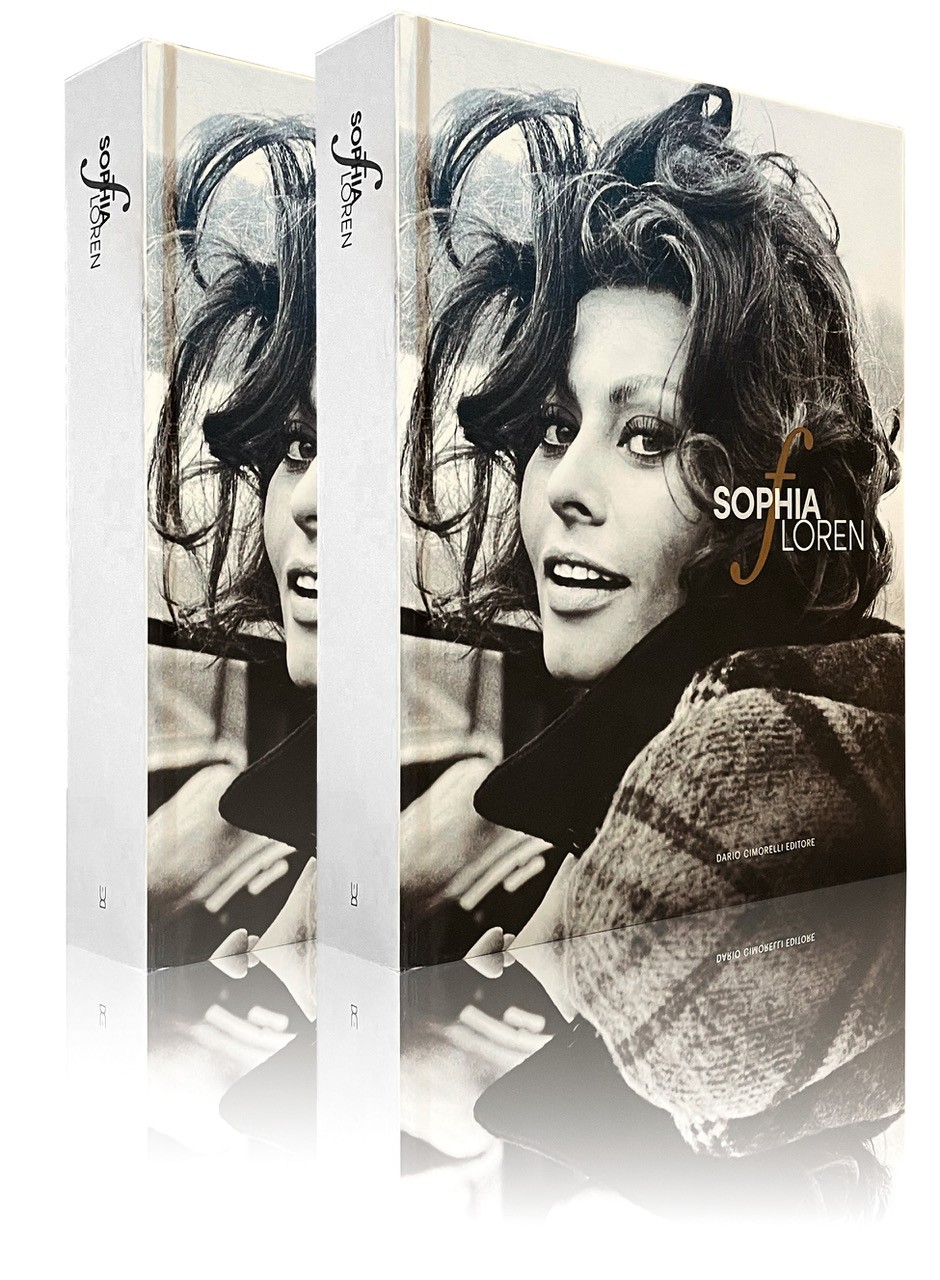
02 Apr “SOPHIA LOREN” BY DARIO CIMORELLI EDITORE, PRINTED BY TECNOSTAMPA, LORETO, ITALY.
A new book is capturing the attention of lovers of cinema, art, and Italian culture: “Sophia Loren”, edited by Marcello Garofalo and published by Dario Cimorelli Editore.
The book tells the story of Sophia Loren, the diva who embodied Mediterranean beauty and Italian talent around the world. From modeling contests and photo novels of the 1950s to the sets of Cinecittà and Hollywood, her career spans over seven decades of cinema, marked by successes and collaborations with great international and Italian masters.
Through a narrative that weaves together biography, cinema, and collective memory, the book also traces Sophia Loren’s private life, marked by her meeting with producer Carlo Ponti, whom she married in 1957 and with whom she shared over fifty years of love and two children, Carlo Jr. and Edoardo. The book thus offers a complete portrait of a woman who, amid personal challenges and artistic triumphs, was able to transform her life into a legend, conveying to the reader the magic and charm of a timeless icon.
Among the key milestones are performances that have left an indelible mark on the collective imagination: from “La ciociara” (which earned her the Oscar for Best Actress) to “Yesterday, Today, and Tomorrow,” from “Matrimonio all’italiana” to “A Special Day,” culminating in the prestigious Oscar for Lifetime Achievement in 1991.
LA CIOCIARA
Based on the novel by Alberto Moravia, *La Ciociara* tells the story of Cesira, a Roman mother who, during World War II, flees the bombed-out capital with her daughter Rosetta to seek refuge in the Ciociaria countryside. But the war catches up with them there as well, culminating in one of the most dramatic and famous scenes in Italian cinema: Cesira, devastated by the violence her daughter has suffered, collapses in the street, curled up in a desperate sob that has become a universal icon of civil suffering.
The film is a powerful indictment of the brutality of war and a poignant portrait of maternal love overwhelmed by history. De Sica’s neorealist style, combined with Loren’s intense performance, transforms individual drama into collective tragedy.
The film won the 1962 Academy Award for Best Actress, Sophia Loren (the first actress to win an Oscar for a non-English-language film); the Prix d’interprétation féminine at the 1961 Cannes Film Festival; and the David di Donatello and Nastri d’Argento awards for Best Actress.
Sophia Loren’s performance in La Ciociara remains one of the most intense and memorable in the history of world cinema: her anguished face and body bent over the asphalt have become an eternal symbol of innocence violated by war.
In the film “Blood Feud Between Two Men Over a Widow: Political Motives Suspected”, directed by Lina Wertmüller, Sophia Loren plays a sensual and determined widow caught in the middle of a conflict between two men that ends in bloodshed. The supposed “political motive” evoked by the title serves as a satirical lens: Wertmüller exposes the hypocrisies of a system in which ideology, power, and machismo overlap to the point of becoming indistinguishable.
Sophia Loren’s performance is of extraordinary dramatic power. Her body and face become a symbolic battlefield between desire and social control.
Loren succeeds in embodying a complex femininity: not a passive victim, but a self-aware figure, capable of navigating a male-dominated world without sacrificing her dignity.
The result is one of the actress’s most mature performances of the 1970s: less iconic than La Ciociara, but equally significant for understanding her ability to blend charisma, drama, and expressive intelligence.
“The Gold of Naples: Sophia Loren walking down the sidewalk, followed by a breathless Giacomo Furia. There is a Neapolitan word that describes that unique, swaggering stride that cleaves the crowd in two: “squarciona”. It embodies the woman of the people, her imperious pride, and her superiority over men. The sequence was filmed by Vittorio De Sica, the most Neapolitan of directors without actually being one. With him, Sophia Loren reached the pinnacle of her performances, with “La ciociara” at the top. […] (From Erri De Luca’s preface to the book “Sophia Loren”)
“No one, like Sophia, has managed to go so far while remaining true to her roots. No one, like her, has managed to navigate the dizzying heights of global fame with the ancient wisdom of her origins.” (From Titta Fiore’s foreword to the book “Sophia Loren”)
Few figures in world cinema embody elegance, talent, and strength quite like Sophia Loren. An actress who has come to symbolize Italy around the world, an Oscar winner, and the muse of legendary directors, her story is one of redemption, determination, and international success.
“The fishmonger sells her fish just as the pizza maker in “L’Oro di Napoli” used to serve her pizzas (…)—a film that became a symbol of 1950s Italian comedy, in which Sofia’s unbridled sensuality contrasts with the marshal’s clumsiness and confusion, which Vittorio De Sica portrays masterfully.”
(from the set of “Pane, amore e…”, 1955, directed by Dino Risi)
Sophia Loren’s arrival in Hollywood in the 1950s was not merely the entry of a European actress into the American film industry; it was the emergence of a strong, independent personality in a world dominated by male stars. Her relationship with the stars of the era was often professional, sometimes affectionate, but always on equal terms.
Throughout her extraordinary international career, Sophia Loren has shared the screen with some of Hollywood’s greatest stars, establishing herself not only as an icon of Mediterranean beauty but also as a true leading lady capable of holding her own alongside the most celebrated stars in world cinema.
From Marcello Mastroianni to Cary Grant, from Frank Sinatra to Clark Gable, from Anthony Quinn to Gregory Peck, and then Paul Newman, John Wayne, Peter Sellers, Richard Burton, and Omar Sharif, William Holden, and Marlon Brando.
The book “Sophia Loren”, published by Dario Cimorelli Editore, is a comprehensive and meticulously curated tribute to one of the most iconic figures in the history of Italian and international cinema. Rich in detail and illustrations, it is ideal for those seeking an in-depth overview of the career and life of a legend, combining historical rigor with narrative readability.
Today, Sophia Loren is much more than a cinema legend: she is a symbol of the ability to transform difficulties into strength and dreams into reality. Her career, spanning over seventy years, has spanned eras and generations, leaving an indelible mark on the history of world cinema.
Her extraordinary life demonstrates that talent, when accompanied by determination and authenticity, can truly become eternal.
SOPHIA LOREN
Edited by Marcello Garofalo
Pages: 496
Format: 23 x 28 cm
Printing: four-color process
Binding: thread-sewn hardcover
Publisher:
Dario Cimorelli Editore
Printer:
Tecnostampa
Loreto (AN) Trevi (PG) Italy
learning more
SOPHIA LOREN