
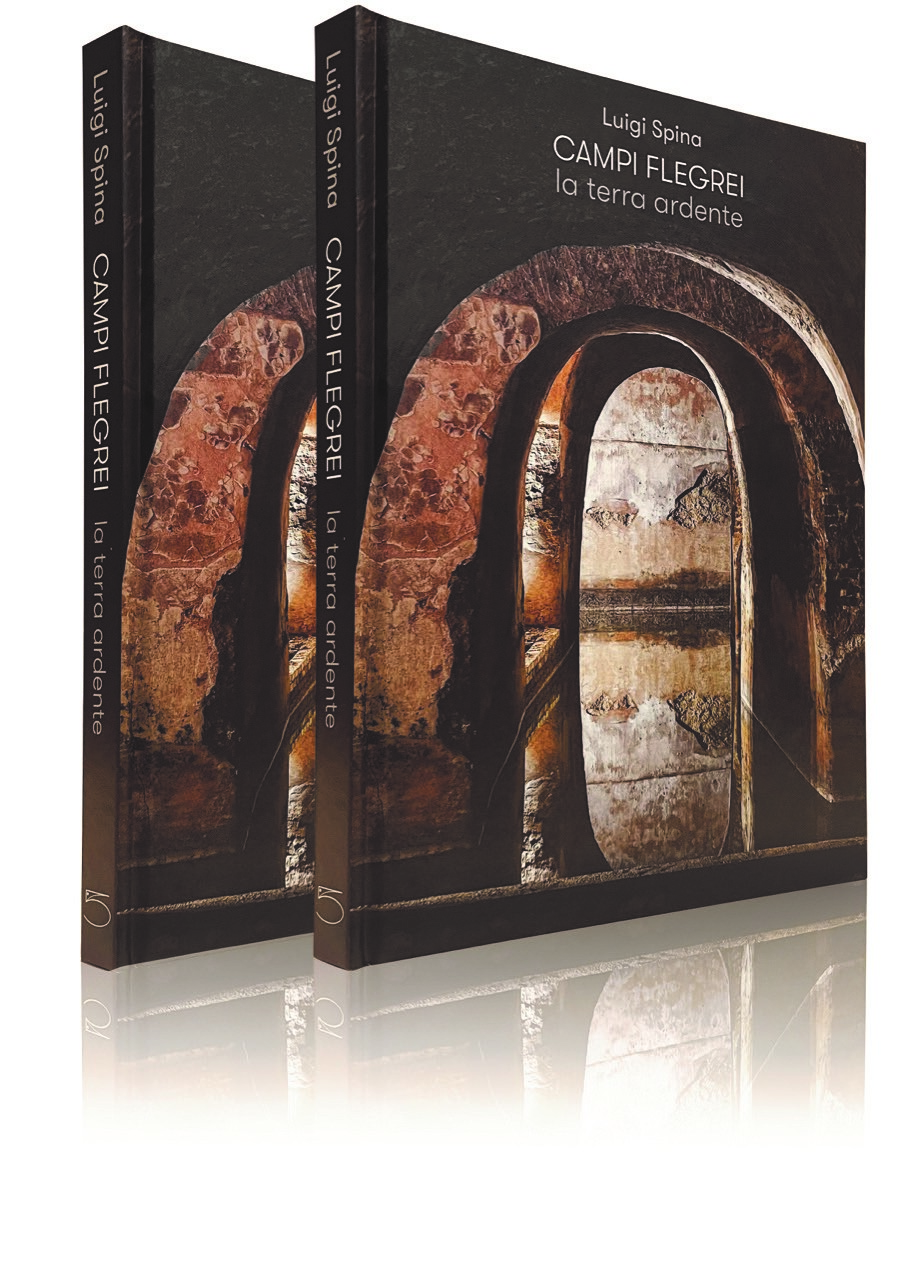
27 Feb “CAMPI FLEGREI, LA TERRA ARDENTE” FROM 5 CONTINENTS EDITIONS, WITH TECNOSTAMPA LORETO, ITALY.
Presented at the Archaeological Museum of the Phlegraean Fields and Castle of Baia in Bacoli—with an opening on November 20, 2025, and an extension until May 3, 2026—the exhibition brings together 25 photographs taken by Spina between 2020 and 2025, the result of field research that began well before the exhibition was set up.
Spina’s interpretative focus is not only to document ancient remains or panoramic views, but to understand the layered fabric of the Campi Flegrei: where the archaeological past coexists with volcanic nature and traces of modern human presence.
Photography as a visual score.
The shots depict iconic places such as the Piscina Mirabilis, the Flavian Amphitheatre in Pozzuoli, the Theatre of Miseno, the Temple of Apollo on Lake Averno and the Temples of Venus and Diana, but the photographer’s gaze is not limited to their historical beauty.
Spina shows how these antiquities are part of a landscape in which the natural and the artificial, the ancient and the recent, order and ruin intertwine. Roads, disused infrastructure, and abandoned industrial buildings coexist with millennial monuments, generating a visual rhythm that the artist interprets as a sort of musical score made up of contrasts and tensions.
The metaphor of rhythm also emerges in the commentary by Fabio Pagano, director of the Campi Flegrei Archaeological Park: “If the landscape were music, it would be jazz.” This idea suggests that the Phlegraean environment is not a static collection of ruins but a dynamic ensemble of harmonies and dissonances, where each element—natural or constructed—plays its own note.
Spina does not seek idealized beauty, but a profound narrative of the place: each image is a step in the relationship between humanity and the environment, between the transience of life and the relentless power of volcanic nature.
Dragonara Cave.
A large hydraulic cistern dug into the tuff, dating back to the Augustan age (around the 1st century BC) and designed to treat or store water. The structure has a quadrangular plan divided into several naves by pillars, with cocciopesto (waterproof plaster) cladding, and was accessible from above through openings in the barrel vault. In the photographs of Luigi Spina, a photographer known for his ability to transform the landscape into an almost archaeological experience, the cave is not just a natural environment: it becomes primordial architecture, a sacred space, a cavity that preserves memory.
Spina often works with calibrated light, which does not invade but caresses. Inside the Dragonara, natural light filters through the entrance and refracts on the irregular surfaces: the rocky walls become textures, the shadows create depth.
The contrast between light and darkness gives the cave an almost theatrical dimension, as if it were a stage carved out of the earth.
Roman Theater of Miseno.
Luigi Spina describes the Roman Theater of Miseno through a silent, sculptural, and meditative photograph, capable of transforming the archaeological ruin into a place suspended between memory and the present. Light is not just illumination, but becomes a narrative tool: it sculpts the space as a theater director would with stage lights. In his images, the theater appears not only as a ruin, but as a living architectural body.
The steps, openings, and arches become almost limbs, cavities, breaths.
Currently, it is accessed from the lower ambulatory, a semicircular space covered with a barrel vault, dug into the tuff and lined with opus vittatum (a Roman building technique in which the facing of the cement core of the masonry consists of rows of bricks alternating with rows of other materials). buried about half its height due to bradyseism, it features the entrance to the radial corridors with brick arches, which led to another more internal semicircular gallery. At the thirteenth corridor, there is a straight gallery, also buried halfway up.
The visitor’s attention is captured by the pleasant sound of the waves, which cannot be seen from inside the theater but can be heard perfectly.
Beyond archaeology: traces of the present
The artist also explores the contemporary presence, documenting how urban occupation, unfinished infrastructure, and abandoned industrial spaces intersect with historical heritage. These images reveal a new “map” of the territory, made up of the remnants of progress that emerge as new ruins alongside the ancient ones.
In this sense, Spina interprets the Archaeological Park not only as an area of historical study, but as a living and transformable environment, where past and present are in constant dialogue. His photography thus becomes a tool for reflection on time, memory, and the ways in which man and nature shape the landscape together.
Spina explores the landscape as a sequence of contrasts, in which the ancient coexists with abandonment, and nature with human intervention. The images alternate between classical ruins and decaying recent infrastructure, new “ruins” of progress overlapping those of history. A landscape in constant transformation, marked by bradyseism, geological instability, and a continuous tension between permanence and change.
CAMPI FLEGREI
La terra ardente.
Photographs by Luigi Spina.
Texts by Fabio Pagano and Luigi Spina
Pages: 220
140 color illustrations
Size: 21.6 x 30.6 cm
Printing: four-color process
Binding: thread-sewn hardcover
Publisher:
5 Continents Editions
Printing:
Tecnostampa
Loreto (AN) Trevi (PG) Italy
for learn more
CAMPI FLEGREI
La terra ardente