
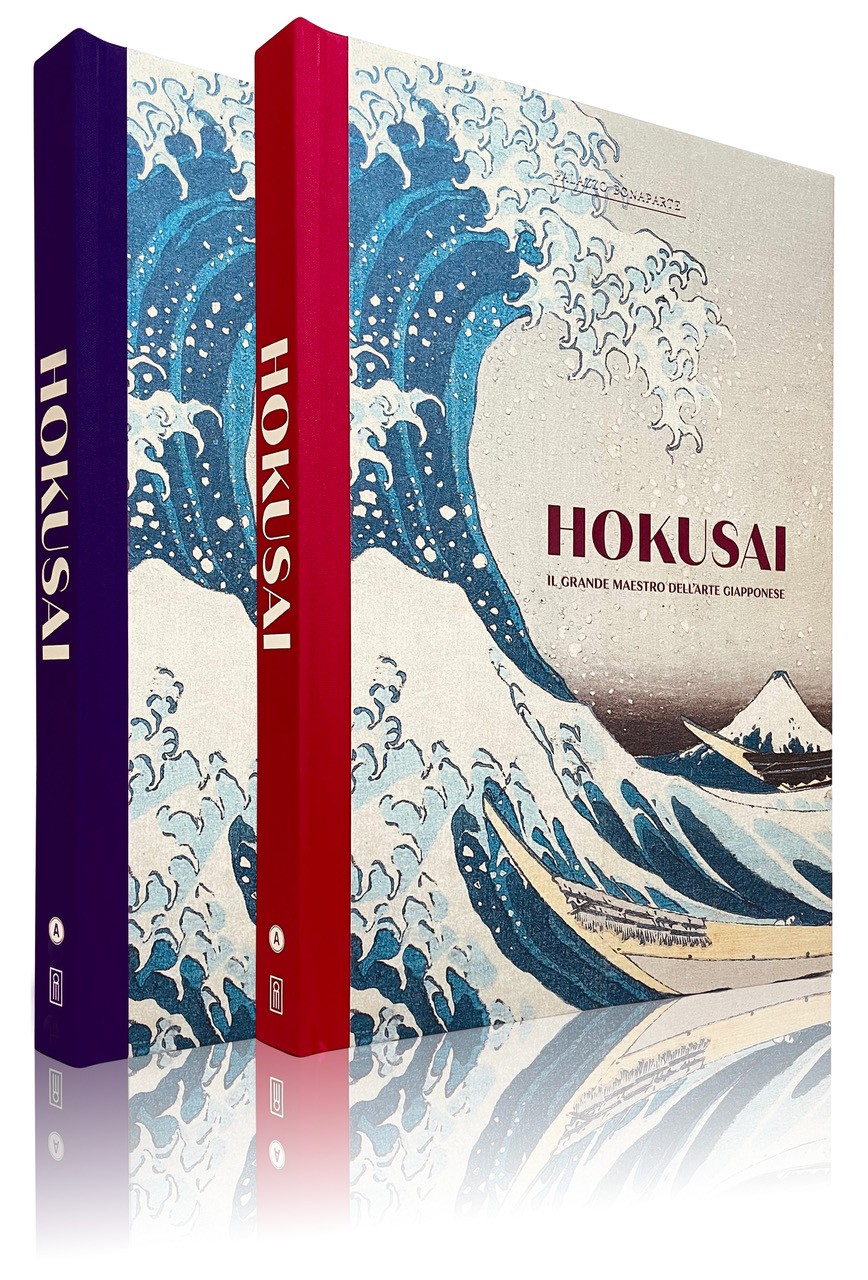
18 Jun HOKUSAI COMES TO ROME Great Japanese art takes over Palazzo Bonaparte. Moebius is editing the catalogue, whilst the printing is being handled by Tecnostampa, Loreto.
For the first time, from 27 March to 29 June 2026, Palazzo Bonaparte is hosting a major retrospective exhibition dedicated to Katsushika Hokusai, the undisputed master of Ukiyo-e and creator of the world-famous Great Wave.
With over 200 works from the National Museum in Kraków, the exhibition traces the entire creative universe of the artist who revolutionised Eastern art and profoundly influenced Western art, from Claude Monet to Vincent van Gogh.
Through iconic landscapes, surging waves, views of Mount Fuji and scenes of daily life, the exhibition takes visitors to the heart of Edo-period Japan, the extraordinary cultural era of the ‘Floating World’.
The major exhibition dedicated to Katsushika Hokusai is proving an extraordinary success, with over 80,000 visitors having already passed through the halls of Palazzo Bonaparte in the first month alone. This result confirms the enduring, powerful and universal appeal that the Japanese master’s work continues to hold for contemporary audiences.
The exhibition also holds great symbolic significance, officially marking the 160th anniversary of diplomatic relations between Italy and Japan. In this context, Hokusai stands as a bridge between East and West, capable of uniting distant cultures through the universal power of his art.
ARTHEMISIA, ART AS AN EXPERIENCE
This major exhibition dedicated to Hokusai is produced and organised by Arthemisia, a leading organisation in the Italian and European cultural scene renowned for staging exhibitions that combine academic rigour, curatorial excellence and a high level of public engagement.
For years, Arthemisia has been bringing exhibitions dedicated to the leading figures of art history to major Italian cities, creating immersive and accessible experiences that transform a visit into a complete cultural journey.
With Hokusai, Arthemisia takes the public on a journey between East and West, bringing to life the visual power, modernity and poetry of one of the greatest artists of all time.
In the photo, on the left is Prof. Alessandra Taccone, economist, academic and leading figure in the Italian cultural scene, currently President of the Fondazione Terzo Pilastro – Internazionale; in the centre is Federico Mollicone, President of the Culture Committee of the Chamber of Deputies; on the right is Iole Siena, President of Arthemisia.
A JOURNEY INTO THE “FLOATING WORLD”
Katsushika Hokusai (born in Edo, now Tokyo, in October/November 1760 and died in Edo on 10 May 1849) was a painter, printmaker and tireless observer of nature and humanity. In his works, water is transformed into pure energy, the landscape becomes a visual rhythm, and everyday gestures take on a surprising poetic power.
The exhibition explores the full range of his artistic output: from polychrome woodblock prints to refined surimono, from portraits of kabuki actors to female figures, right through to manga and the famous series dedicated to Mount Fuji and Japan’s waterfalls.
Alongside the masterpieces are kimonos, armour, musical instruments, lacquerware and precious Japanese artefacts that immerse the public in the aesthetics and spirituality of nineteenth-century Japan.
A journey that speaks not only of art, but of culture, nature, movement and wonder.
THE “OLD MAN MAD ABOUT PAINTING”
In the final years of his life, Hokusai signed many of his works with the name “Gakyō rōjin” ( 画狂老人 ), the “Old Man Mad About Painting”. A description that perfectly captures his tireless artistic quest.
It was precisely after he turned seventy that he produced some of his most famous masterpieces, including The Great Wave off Kanagawa. He famously described his creative journey with the words: “By the age of ninety, I shall have penetrated the mystery of nature. By the age of one hundred, I shall be a marvellous artist.”
The exhibition captures the full modernity of an artist who, even today, is capable of bridging East and West, confirming his status as one of the most influential figures in the history of universal art.
“Ever since I was six years old, I have been in the habit of drawing all sorts of things. Although I produced numerous drawings after the age of fifty, none of my works created before the age of seventy are truly worthy of note.
It was only from the age of seventy-three that I truly understood the true forms of animals, insects and fish, and the nature of plants and trees.
Consequently, by the age of eighty-six I shall have made ever greater progress, and by the age of ninety I shall have come even closer to the essence of art.
By the age of one hundred I shall have reached a magnificent level, and by the age of one hundred and ten every dot and every line will be alive.”
画狂老人
THE EXTRAORDINARY COLLECTION OF FELIKS “MANGGHA” JASIEŃSKI
Among the exhibition’s most valuable highlights is the exquisite collection of surimono that belonged to Feliks Jasieński, a great collector and passionate promoter of Japanese art in Europe during the late 19th and early 20th centuries.
Known by the nickname “Manggha”, Jasieński collected works of exceptional quality, making a decisive contribution to the dissemination of Japanese aesthetics in the Western world. His collection comprises around 50 extraordinary prints by Katsushika Hokusai, testifying to the technical and poetic refinement achieved by the artist.
The surimono — precious prints produced in limited editions and intended for a cultured audience — represent one of the absolute pinnacles of Japanese printmaking. Characterised by fine paper, refined metallic effects, embossing and an extraordinary richness of colour, these works reveal the full delicacy of Hokusai’s line and his ability to transform every image into a small masterpiece.
The exceptional quality of Jasieński’s collection makes this section one of the most fascinating highlights of the entire exhibition, offering the public a rare opportunity to admire works normally held in museum collections that are difficult to access.
“ONE HUNDRED GHOST STORIES”: HOKUSAI’S MYSTERIOUS JAPAN
Among his most fascinating works are the images inspired by the One Hundred Ghost Stories, in which the master explores the most mysterious side of Japanese culture through spirits, apparitions and legendary figures.
A standout example is the ‘Villa of the Plates’, linked to the legend of Okiku, the young maid whose spirit continues to count the lost plates from the bottom of a well, becoming one of the most famous ghosts in Japanese folklore.
Alongside these visions appears the famous grinning Hannya, a Noh theatre mask representing a woman transformed into a demon by jealousy and grief. With her unsettling smile, sharp horns and intense gaze, Hokusai creates images suspended between theatre, psychology and the supernatural, revealing the full modernity and expressive power of his art.
Hokusai shifted the focus of ukiyo-e from portraiture to landscape art, creating iconic series such as the Thirty-six Views of Mount Fuji (including the famous Great Wave off Kanagawa), Famous Waterfalls and Views of Famous Bridges.
Hokusai’s works had a profound influence on Western art, particularly on Impressionist and Post-Impressionist painters such as Claude Monet and Vincent van Gogh.
HOKUSAI ON EXHIBITION
The exhibition first introduces the public to the world of Ukiyo-e, the famous ‘Floating World’ of the Edo period, through the earliest prints of the Japanese tradition. An entire section is then dedicated to Hokusai’s constant name changes, reflecting his ceaseless artistic and personal evolution.
Ample space is devoted to the great landscapes that have immortalised the master: from views of the stations along the Tōkaidō road to the masterpieces of the Thirty-six Views of Mount Fuji, including the famous Great Wave off Kanagawa.
The exhibition continues with the extraordinary Hokusai Manga, collections of sketches, figures and scenes of daily life that surprisingly foreshadow the language of the modern comic strip.
Alongside the artworks, over 180 period objects — samurai armour, swords, kimonos, lacquerware and cloisonné — convey to the visitor the charm of the spirituality, daily life and aesthetics of Japan at that time.
Accompanying the exhibition is the prestigious catalogue published by Moebius and printed by Tecnostampa Pigini Group, a leading Italian name in the graphic arts sector. The publication brings out every detail of Hokusai’s works thanks to meticulous fine-tuning of the print profiles, particular attention to the original colours, and a precise and punctual service. The result confirms the exceptionally high quality of the Loreto-based printing centre, which has transformed the catalogue into a true work of art, designed to complement and extend the exhibition experience beyond the exhibition halls.
THE GREAT MASTER OF JAPANESE ART
edited by Beata Romanowicz
Pages: 240
Size: 24×34 cm
Printing: four-colour process
Binding: thread-sewn hardback
Available in 2 versions:
Italian – English
Publisher: Moebius
Printed by: Tecnostampa
Loreto (AN) Trevi (PG) Italy