
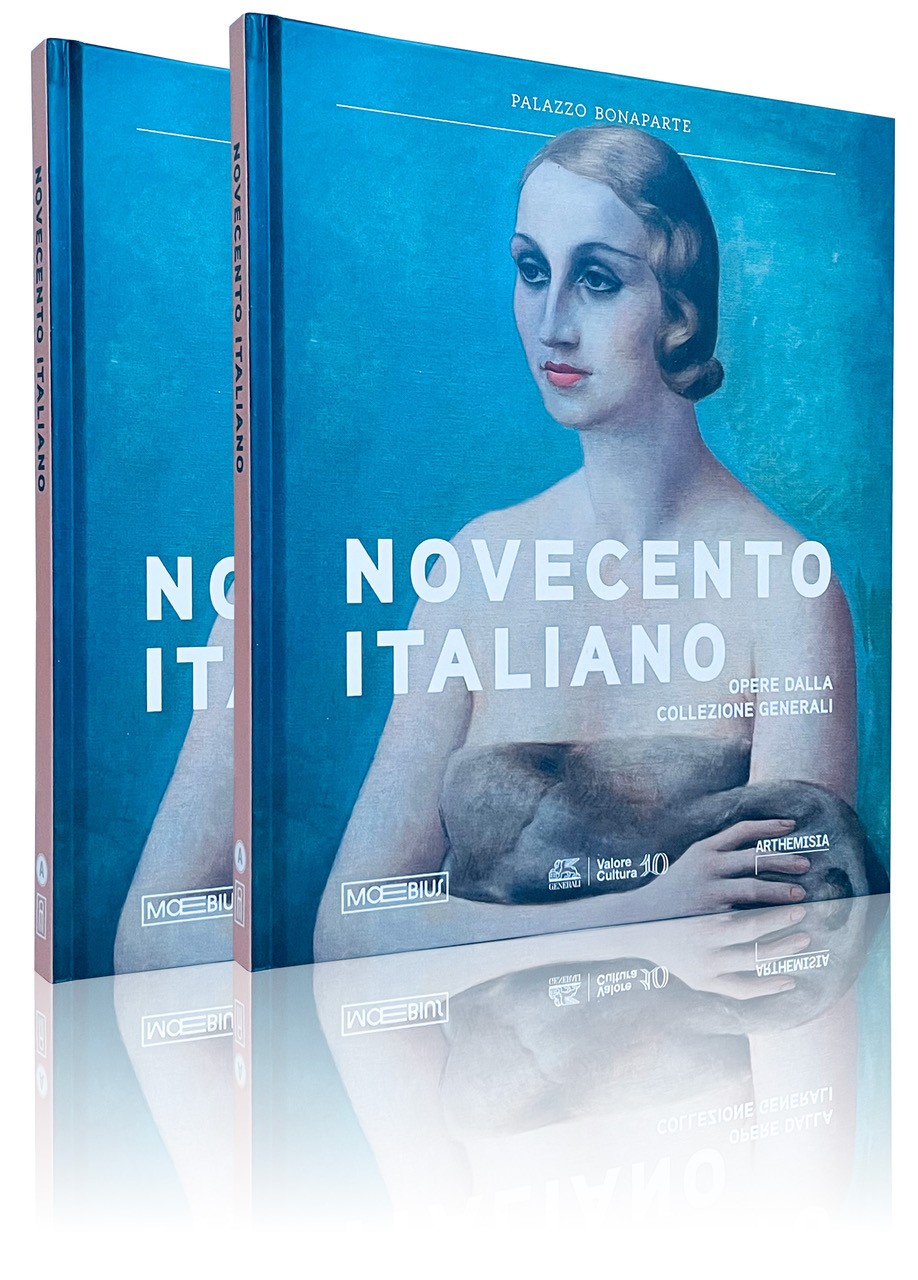
05 Aug NOVECENTO ITALIANO The masterpieces of the Generali Collection on display at Palazzo Bonaparte, thanks to ‘Moebius’ and ‘Artemisia’ – the exhibition catalogue published by Tecnostampa, Italy
From 14 July to 23 August 2026, Palazzo Bonaparte will exceptionally open its doors to this extraordinary treasure with the exhibition “Italian 20th Century: Works from the Generali Collection”, a show bringing together over fifty masterpieces normally held in the Group’s private collection and presented to the public together for the first time.
The thematic itinerary of the exhibition, curated by Costantino D’Orazio and produced by Arthemisia under the patronage of the Ministry of Culture, the Lazio Region and the Municipality of Rome, traces a century of transformation through the eyes of artists such as Umberto Boccioni, Giorgio de Chirico, Gino Severini, Felice Casorati, Mario Sironi, Filippo de Pisis, Antonio Donghi, Massimo Campigli, Fausto Pirandello and many other leading figures in Italian figurative art. Adding further prestige to the exhibition is the inclusion of Gustav Klimt’s famous painting *The Three Ages*, on loan from the National Gallery of Modern and Contemporary Art in Rome.
Visitors are greeted by the magnificent “Le due amiche” (1916), an oil on canvas by Umberto Boccioni – a work that symbolises the transition from the nineteenth to the twentieth century – which introduces a tour rich in masterpieces, guiding visitors through the major artistic movements and themes of the last century.
The collection was established in the early 1980s as the result of an innovative vision: not simply to collect works to embellish the workplace, but to build a heritage capable of recounting, through art, the transformations of Italian society, its aspirations, its changes and its contradictions. Over time, it has become one of the most significant corporate collections in Italy, a shining example of cultural responsibility and the promotion of our shared heritage.
The more than fifty works in the Generali Collection, on display to the public for the first time at Palazzo Bonaparte, represent one of the most delightful surprises of the Roman exhibition season. An extraordinary collection, normally housed within the Generali Group’s prestigious corporate collection, which has been exceptionally brought out of its private quarters to offer visitors a journey through 20th-century Italian art. All this with free admission and a spectacular finale: the presence of Gustav Klimt’s *The Three Ages*, a true masterpiece featured in the exhibition.
The appeal of the exhibition lies above all in the opportunity to admire works which, until now, had remained almost exclusively part of the Group’s private collection. These are paintings of extraordinary quality that bear witness to a forward-thinking cultural vision: not merely a collection of masterpieces, but a journey that traces the evolution of Italian art and society throughout the 20th century.
The official opening of “Novecento italiano. Works from the Generali Collection” was marked by the presence of the President of the Republic, Sergio Mattarella, who, through his attendance, sought to highlight the cultural and institutional significance of an initiative set to become one of the most important events of the Roman summer.
The inauguration thus took on a significance that went beyond the mere opening of an exhibition. The Head of State’s presence represented recognition of the role that culture continues to play in shaping national identity, and of the ability of public institutions and businesses to collaborate in safeguarding and promoting Italy’s artistic heritage. President Mattarella’s arrival was welcomed by institutional authorities, representatives of the Generali Group and the organisers of the initiative, highlighting the value of a project that combines social responsibility, cultural promotion and the enhancement of the national heritage. The Head of State then toured the exhibition, pausing in front of some of the collection’s most representative works, on a journey through the major periods of 20th-century Italian art.
The institutional significance of the inauguration was further underlined by a gesture of great symbolic importance. The President of the Republic, Sergio Mattarella, was presented with a copy of the book “Novecento Italiano”, produced in a special edition prepared specifically for the occasion.
THE CATALOG “NOVECENTO ITALIANO”
The volume, edited by Costantino D’Orazio and published by Moebius, captures the breadth and richness of the Generali Collection through a narrative that weaves together art history, cultural memory and the story of the Italian 20th century. For the production of the catalogue, the Milan-based publishing house drew on the expertise of Tecnostampa Loreto, a leading name in the field of art printing and high-quality publishing, chosen to ensure the highest quality in image reproduction, colour rendering and attention to typographical detail.
The works engage with one another through the major themes that ran through the last century – progress, identity, landscape, the body, work and modernity – offering an interpretation that goes beyond a mere chronological sequence of artists.
Alongside reproductions of the works, the catalogue features critical essays, historical analyses and texts that trace the origins of the collection, which was established in the early 1980s on the basis of an innovative vision: to build a cultural heritage not intended solely for representational purposes, but capable of interpreting the transformations of Italian society through art.
Leafing through the pages of the volume, the reader encounters the leading figures of twentieth-century Italy – from Umberto Boccioni to Giorgio de Chirico, from Gino Severini to Felice Casorati, from Mario Sironi to Filippo de Pisis, and many other artists who have shaped the century’s visual culture – and comes to understand how each work forms part of a broader narrative, woven from relationships, influences and shared visions.
The catalogue’s editorial quality helps to make it a treasured object. The choice of materials, the fidelity of the reproductions, the clarity of the images and the sophistication of the presentation reflect the very idea that underpins the exhibition: to make a heritage of extraordinary value accessible without compromising on excellence. This balance between editorial vision and production quality exemplifies the collaboration between Moebius and Tecnostampa Loreto, which has translated the volume’s scientific and artistic value into a publication of the very highest standard.
Opere dalla Collezione Generali
edited by Agostino d’Orazio
Pages: 136
Size: 24 x 28 cm
Printing: four-colour process
Binding: thread-sewn hardback
Publisher:
MOEBIUS
Printer:
TECNOSTAMPA
Loreto (AN) Trevi (PG) Italy